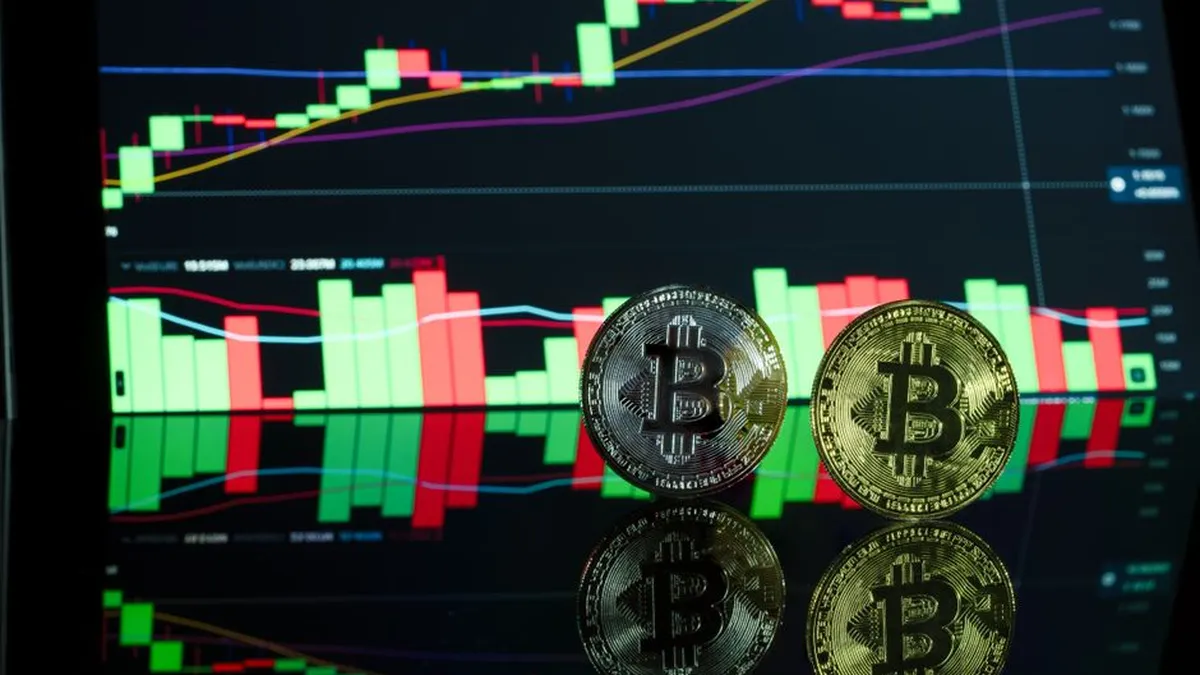


BTC printed $80,529 at the open of Singapore trading hours on Monday, May 4, 2026, its first touch above $80,000 since January 31. Bitcoin hadn't been above the level for 13 weeks. The break coincided with Consensus 2026 opening in Toronto and, within hours, the market gave most of it back: a Reuters-cited report of a suspected Iranian missile strike near Jask Island sent BTC back to $78,600, a 1.5% flush in minutes with ETH, SOL and DOGE selling sharply alongside, per CoinDesk. By Tuesday, May 5, BTC was stalling just below $80K with neither side in control.
I track and trade these setups through AO Shadow — signals auto-copied to Bybit via WebSocket in under 200ms. Free Sentinel tier, no credit card →
The first credible bull-trend signal since BTC peaked at $126,000 in October 2025 and shed nearly half its value into the spring 2026 lows. That's the context. The question is what powered Monday's break: genuine spot accumulation or short-liquidation fuel?
Both, in sequence. $630 million in net U.S. spot Bitcoin ETF inflows landed on Friday, May 1, the strongest single-session flow in weeks, per CoinDesk. That built the structural bid. Then $300 million in bearish bitcoin positions liquidated in 24 hours, including $108 million flushed in a single hour at the highs, per NewsBTC. Shorts pressed into improving fundamentals and got stopped out. The squeeze amplified real demand. It didn't manufacture it.
The dominant short trade is dead. Whatever comes next requires fresh spot buying.
The $300 Million Short Flush: What the Liquidation Data Actually Shows
The $300 million in short liquidations that hit over the 24 hours ending Monday, May 4, 2026 wasn't a uniform cascade. The $108 million single-hour flush at $80,529 shows how algorithmic stop orders concentrate at round-number levels. When BTC approaches $80,000, orders stacked there trigger automatically, pushing price higher, triggering more orders, pushing price further still. BTC surged from the mid-$79,000 range to $80,529 as the cascade compounded. Bitcoin was already up roughly 19% over the past month heading into Monday, outpacing the S&P 500's approximate 10% gain over the same period, per crypto.news. Shorts who built positions against a strengthening trend got caught at the worst entry. The squeeze didn't create demand from nothing. It forced stubborn shorts to close positions built against improving fundamentals: $630 million in ETF inflows and accelerating Senate progress on the CLARITY Act cryptocurrency regulatory framework.
Across 2,755 tracked trades on AO Trading's public dashboard, the group runs a 63.96% win rate with systematic entry and exit protocols on every position. The $300M in liquidated shorts represents the opposite: directional bets held without structured exits. Ryaan runs 74.1% accuracy over 104 trades on the same platform; AO Crusher logs 69.3% over 1,035 trades. That consistency doesn't come from catching every squeeze. It comes from not being on the wrong side when one hits.
QCP Capital's research note, cited by Fortune, framed it plainly: "the rally suggests the market may be drawing strength from a wider base of support beyond that single narrative." Wider base is the signal. The bid wasn't just liquidations.
ETF Inflows and the CLARITY Act: The Structural Shift Behind the Break
The $630 million in net U.S. spot Bitcoin ETF inflows on Friday, May 1, 2026 has a specific explanation: the CLARITY Act cryptocurrency regulatory framework moved from a distant legislative hope to a near-term calendar event. Senate Banking Committee Chairman Tim Scott stated directly, "We're in the red zone," per Fortune, flagging that committee markup was targeted for May with a Senate floor vote planned for June or July. A late-April compromise between Senators Tillis and Alsobrooks on stablecoin yield language resolved the technical dispute that had stalled the bill in committee for months. When regulatory clarity acquires a date rather than a vague "later this year," institutional capital doesn't wait for the vote. It front-runs the announcement. The ETF inflow was that front-run. The $80K break was the downstream result.
Bitcoin's path to Monday started at a $126,000 cycle peak in October 2025. Over the following months, the price shed nearly 50% as ETF outflows and macro risk-off flows compounded with stalled U.S. crypto legislation. The April 28 CoinDesk session described traders "turning cautious" after repeated $80K rejections. That caution was the setup Monday's break interrupted.
Whether the bid holds depends on whether ETF inflows stay positive this week. That's the only tape worth watching.
Trading Bitcoin breakouts and pullbacks around macro catalyst events? AO Shadow automates TP, SL, and DCA on Bybit — copy from a verified trade ledger, not a Telegram screenshot. $49 first month with code BONKERS, then $149/mo. Start the 7-day Shadow trial — no API keys required.
Why Bitcoin Dropped Back from $80K: The Iran Headline and the Options Fence
Bitcoin dropped from $80,529 to $78,600 in hours for two reasons that operated simultaneously, and separating them matters for risk sizing. The Iran headline was the trigger. A Reuters-cited report of a suspected missile strike on a U.S. patrol boat near Jask Island hit while BTC was consolidating near the highs. ETH, SOL and DOGE all sold sharply alongside, per CoinDesk. The 1.5% drop in under ten minutes reflects how thin the bid was at the highs once the squeeze had cleared the shorts. The second force is structural. As Fortune's analysis noted: "There are a large number of call options sitting on $80,000, meaning options dealers who are buying those contracts must hedge their exposure by selling Bitcoin as the price climbs, putting a kind of 'electric fence' around the $80,000 mark." That dealer hedging pressure persists until the options expiry rolls off. Both forces hit a market that had already burned through its short-squeeze fuel. Iran headlines into a market where dealers are positioned to sell BTC strength: that's why 1.5% in minutes, not over a session.
| Level | Context | What It Means |
|---|---|---|
| $80,529 | May 4, 2026 intraday high | First print above $80K since Jan 31, 2026 |
| $80,000 | Options fence / resistance | Heavy call strike; dealer selling until expiry rolls |
| $78,600 | Post-Iran reaction low | Immediate support to watch |
| $75,000 | Next major support | Re-test target if $80K fails |
| $90,000-$100,000 | 2025 positioning shelf | Target if $80K confirmed as support |
| $126,000 | October 2025 cycle peak | Macro context |
What a Disciplined Trader Does With This Setup
The $80,000 zone is the cycle pivot. The framework is binary. Close and hold above $80,529 on the daily chart, and the level flips to support with a path toward the $90,000-$100,000 shelf where heavy 2025 positioning sits. Fail to hold, and retail longs who bought Monday's break are trapped above a line that has now rejected price twice in 24 hours, opening a re-test of $75,000. Position sizing should price two specific risks. First, the options fence: dealer gamma hedging continues to suppress upside until that expiry rolls off, so don't size for a clean break through $82,000 or $85,000 without confirming the gamma has cleared. Second, Strait of Hormuz headline risk. The Iran report moved BTC 1.5% in minutes on May 4. Not a hypothetical anymore. Size positions so that a second geopolitical flush doesn't force a manual exit at the worst time.
The dominant short trade is gone. $300M+ in shorts removed in 24 hours. Further upside requires real spot demand: ETF inflows and treasury buyers like Strategy, with CLARITY Act Senate markup headlines as the near-term catalyst. That's a slower and less explosive fuel source than a squeeze.
AO Trading tracked 459 position copies in the seven days ending May 5, with 94 active copy users running live positions through Shadow. That's the practical answer to how you trade through geopolitical noise at 3am: automated stop-loss and position protection rather than a manual decision under pressure. The group's 167,830 total profit across 2,755 tracked trades is public at AO's live results, and it shows what systematic discipline looks like across a full cycle including the volatility Monday delivered.
For a deeper breakdown of how verified leaderboard win rates hold up under cycle volatility, see The 27-Point Gap: How to Read Verified Crypto Trader Leaderboard Risk Signals in 2026.
Watch two catalysts this week: the daily ETF flow tape and CLARITY Act Senate markup headlines. Everything else is noise.
FAQ
Why did Bitcoin drop to $80K?
Bitcoin broke above $80,000 for the first time since January 31, 2026, printing $80,529 on May 4. Bitcoin then dropped back to $78,600 after a Reuters report cited a suspected Iranian missile strike near Jask Island, triggering a broad crypto sell-off. ETH, SOL and DOGE all fell alongside. The pullback developed over roughly four hours from the high.
Why is Bitcoin stopping under $100,000?
Call options at round-number strikes force options dealers to sell BTC as price climbs toward $80,000, $90,000 and $100,000. That dealer hedging creates ceiling pressure at each level. Getting through requires sustained ETF buying large enough to absorb the selling. The $630 million inflow on May 1 got BTC briefly through $80K but couldn't hold against the Iran headline sell-off.
Was the $80K break a short squeeze or real spot demand?
Both, in sequence. $630 million in spot ETF inflows on May 1 built the structural bid. Then $300 million in short liquidations, including $108 million flushed in a single hour, amplified the move. The squeeze forced shorts out of positions built against improving fundamentals: CLARITY Act progress and the ETF flow reversal. QCP Capital called it "a wider base of support beyond that single narrative."
What's the biggest risk for Bitcoin bulls right now?
Two risks: geopolitical headline exposure from the Strait of Hormuz, which already moved BTC 1.5% in minutes on May 4, and the $80K options fence from dealer gamma hedging. Both suppress upside until the expiry rolls off. Further upside requires sustained spot demand from ETF inflows and treasury buyers. The $300M in cleared shorts won't provide the same fuel again.
What happens if Bitcoin fails to hold $80,000?
A confirmed daily close below $80,000 traps Monday's breakout buyers and opens a re-test of $75,000. That also undermines the regulatory clarity trade, since CLARITY Act progress is already partially priced in. Bulls need a confirmed hold of $80,529 as support. A wick above the number without a follow-through close is not a breakout.
If you're managing live positions through the $80K decision zone without automated protection, the Iran headline on Monday is the exact scenario that exposes that gap. AO Shadow automates stop-loss and position protection on Bybit so a geopolitical sell-off at 3am doesn't require a manual decision. The 7-day trial gives you a clean window to test the risk controls while the $80K battle is still live, with 94 copy users and 459 positions copied in the past seven days providing real market stress-testing behind it.