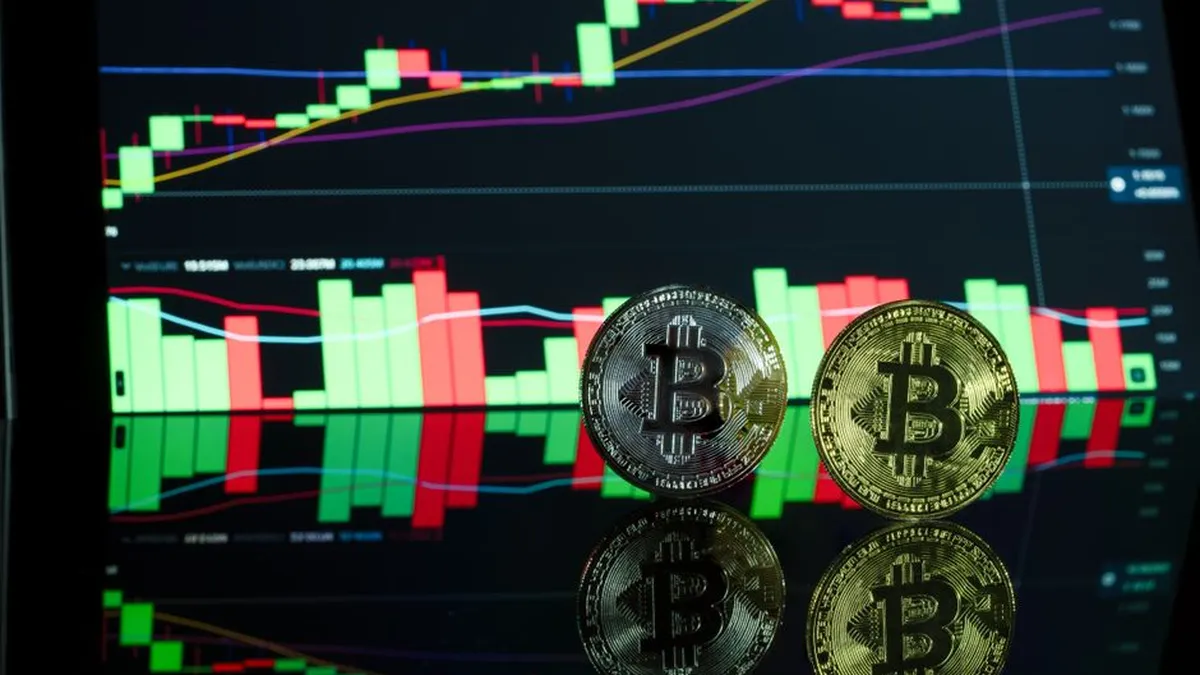


Bitcoin is trading at $70,523 after losing nearly half its value since October 2025. The decline from the all-time high above $126,000 has been relentless: five consecutive red months, a 15% drop in February alone, and a crypto fear and greed index parked in extreme fear territory. Funding rates have been negative since early March.
I track and trade these setups through AO Shadow — signals auto-copied to Bybit via WebSocket in under 200ms. Free Sentinel tier, no credit card →
But here's what the price chart isn't telling you.
Spot Bitcoin ETFs absorbed 11,213 BTC (roughly $734 million) in net inflows over the past seven days, according to CoinDesk. Long-term holders slashed their selling by 87% through February, with net disposals falling to just -31,967 BTC by March 1. Someone is buying. And they're buying into a market that most retail traders have abandoned.
The real story isn't the price. It's the fight happening in Washington over the CLARITY Act of 2026, a bill that would finally draw a hard line between SEC and CFTC jurisdiction over crypto assets. The White House has openly accused banks of sabotaging this legislation. That accusation changes the game.
Bitcoin
Outperforms Everything During a Shooting War
Bitcoin has climbed roughly 7% since the US-Iran military conflict escalated on February 28. That single data point deserves more attention than it's getting. Over the same period, the S&P 500 dropped about 1%. Gold fell 3%. Silver cratered 9%. Brent crude spiked briefly above $100 per barrel and the VIX hit 25, its highest reading in over a year.
"Bitcoin has risen about 7% since the Middle East conflict escalated on Feb. 28, outperforming the S&P 500, Nasdaq 100, gold and silver," noted James Van Straten, CoinDesk analyst.
That outperformance during a genuine geopolitical crisis breaks the old narrative. BTC was supposed to be a risk-on asset that dumps when fear spikes. It didn't. The decentralized network processed transactions while traditional markets panicked. Whether this marks a permanent shift in Bitcoin's correlation profile or a temporary dislocation, I don't know. Nobody does. But the data is the data.
For traders watching the broader macro picture, Bitcoin's relative strength against equities and commodities during active military conflict is worth tracking into April.
The Four-Year
Cycle: A 30% Crash or a Bear Trap?
ZX Squared Capital thinks Bitcoin drops another 30% from here.
"Bitcoin's price is convincingly in deep bear market territory now. We expect a further 30% price drop during 2026," said CK Zheng, founder of ZX Squared Capital, in a CoinDesk interview.
The logic is straightforward. The April 2024 halving cut the block reward to 3.125 BTC. Historically, Bitcoin peaks 16 to 18 months after each halving. The October 2025 high above $126,000 landed right at 18 months. Previous cycles in 2013, 2017, and 2021 all produced 70-80% drawdowns from peak. The current decline of approximately 50% hasn't reached those depths yet.
A 30% drop from current levels puts BTC near $48,000 to $50,000. That's the cycle bear case.
| Metric | Current | Bear Case Target | Historical Precedent | | BTC Price | $70,523 | $48,000-$50,000 | 70-80% drawdowns in prior cycles | | Decline from ATH | ~50% | ~62% | 2018: -84%, 2022: -77% | | Key Support | $65,000 | Break triggers crash | Neckline of 4H H&S pattern | | Key Resistance | $73,300 | Must reclaim for reversal | 200 EMA cluster zone | | ETF Weekly Inflows | $734M (11,213 BTC) | Structural floor | No precedent pre-2024 |
| LTH Net Selling | -31,967 BTC (down 87%) | Capitulation not yet seen | Selling exhaustion signal |
|---|
But Zheng's own framing reveals the weakness in the cycle argument. He admitted that ETFs and digital asset treasury companies represent only about 10% of total crypto market cap. That's his bear case: institutions aren't big enough to prevent forced selling cascades. Fine. But that 10% didn't exist in any prior cycle. Spot ETFs were approved in January 2024. The structural demand floor they create is new. Comparing 2026 to 2018 or 2022 without accounting for that is lazy analysis.
I'm not calling a bottom. The head-and-shoulders pattern on the 4H chart has a measured move target around $59,500 if the neckline at $65,000 breaks. That's a real risk. But the "cycle says crash" argument ignores that every cycle has been less severe than the last.
The CLARITY
Act and Why Washington's Bank Fight Matters for BTC Price
The CLARITY Act of 2026 is working its way through Congress right now. It would separate SEC and CFTC authority over cryptocurrency, ending years of jurisdictional confusion that has kept institutional capital on the sidelines.
The White House has accused the banking lobby of actively sabotaging both stablecoin legislation and market structure bills. That's not a subtle political maneuver. That's the executive branch publicly naming an enemy of crypto regulation.
Why should a BTC trader care?
Because institutional allocators need regulatory clarity before they can increase position sizes beyond current levels. Pension funds, endowments, sovereign wealth, all of them have compliance committees that won't approve crypto exposure while the SEC and CFTC fight over who regulates what. The CLARITY Act solves that. If banks kill it, the institutional bid stays capped at current levels.
The market is pricing in none of this. Bitcoin sits in a tight range between $65,000 support and $73,300 resistance while a regulatory battle that could define the next five years of crypto market structure plays out in committee rooms. The disconnect between sideways price action and the significance of this political moment is striking.
Traders using tools like AO Shadow to track institutional positioning should watch for a breakout in either direction once the CLARITY Act gets a floor vote.
What Smart
Money Is Actually Doing
Forget what people say. Watch what they do.
Spot ETF buyers accumulated 11,213 BTC in a single week while price drifted lower. That's counter-trend buying at scale. Long-term holders, wallets that haven't moved coins in over 155 days, cut their selling by 87% through February. The total crypto market cap sits at roughly $2.39 trillion, with Bitcoin's share at $1.41 trillion.
Negative funding rates and extreme fear readings are historically contrarian bullish signals. Not always. Not guaranteed. But the setup rhymes with previous accumulation zones.
"Individual investors' psychological behaviors reinforce predictable market patterns, keeping Bitcoin more like a speculative asset than a safe haven like gold," Zheng told CoinDesk. He's right that retail behavior is predictable. Retail panics at bottoms and FOMOs at tops. That pattern is exactly why the current fear reading is interesting.
Bitcoin has now mined its 20 millionth coin. Fewer than 1 million BTC remain to be mined over the next century. Supply isn't expanding. If the CLARITY Act passes and institutional demand accelerates while supply growth approaches zero, the math gets very simple.
But if $65,000 breaks, none of that matters in the short term. Liquidation cascades don't care about supply curves.
Here's what I'm watching: a daily close above $73,300 flips my bias bullish. A daily close below $65,000 and I'm targeting $59,500 first, then $48,000 if that doesn't hold. Position sizing needs to account for elevated volatility. The VIX at 25 and crude above $100 mean whipsaws in both directions. Don't get chopped up.
FAQ
How much is $1 dollar in Bitcoin?
At Bitcoin's current price of approximately $70,523, one US dollar buys roughly 0.0000142 BTC. This rate changes constantly as BTC trades 24/7 on global cryptocurrency exchanges. The USD to BTC conversion depends on which exchange you check, since prices vary slightly between platforms like Binance, Coinbase, and Kraken.
Why is
Bitcoin falling?
Bitcoin dropped nearly 50% from its October 2025 all-time high above $126,000 due to the four-year halving cycle peaking on schedule, Trump-era global tariffs pressuring equities, and the US-Iran military conflict killing risk appetite. February 2026 alone delivered 15% losses. The crypto fear and greed index now sits in extreme fear territory.
Will Bitcoin recover in 2026?
No one can predict Bitcoin's price with certainty. Spot ETF inflows of $734 million in one week and long-term holder selling dropping 87% suggest institutional accumulation at current levels. The CLARITY Act of 2026 could provide regulatory clarity that unlocks new capital. But a break below $65,000 support risks another 30% decline to $48,000-$50,000.
Is Bitcoin a safe haven during war?
Bitcoin rose approximately 7% since the US-Iran conflict escalated on February 28, 2026, while the S&P 500 fell 1%, gold dropped 3%, and silver lost 9%. This single episode doesn't prove Bitcoin is a safe haven, but the outperformance during active military conflict challenges the pure risk-on narrative.
Want to trade these moves automatically? AO Shadow copies live signals from professional traders directly to your Bybit account via WebSocket — entry, take-profit and stop-loss placed in under 200ms. The Sentinel tier is free forever, no credit card required. Start your free trial →