
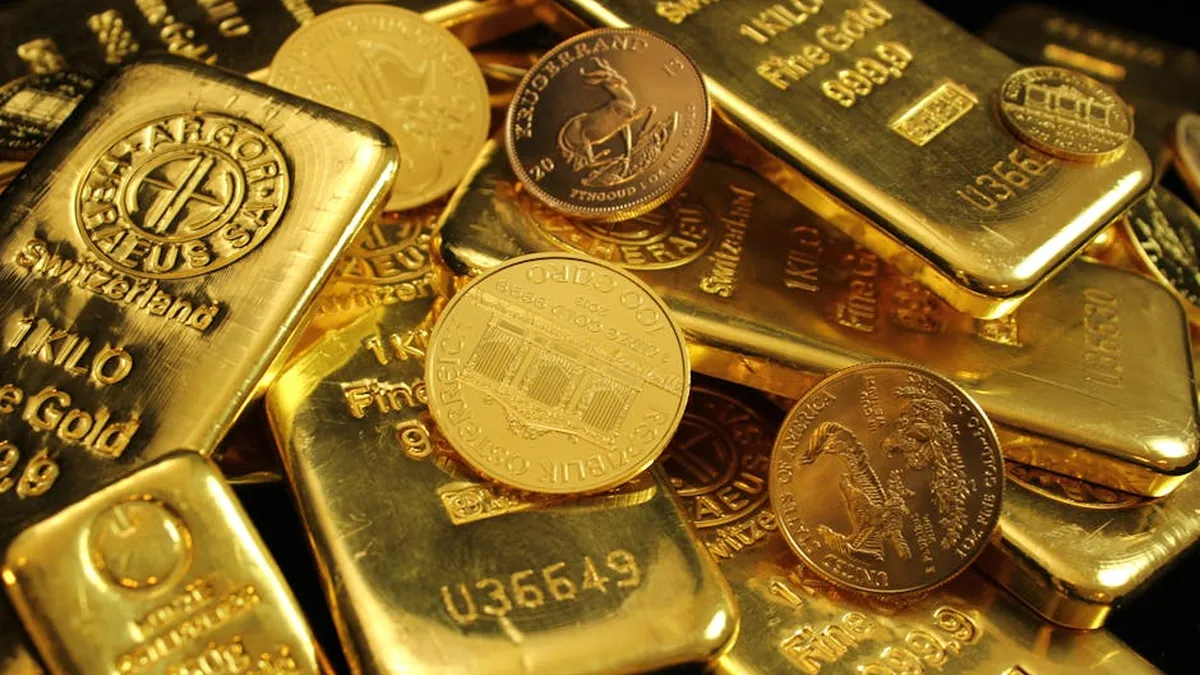
The gold price forecast for 2026 is unambiguously bullish. Spot gold trades at $4,831.56 on April 18, 2026, up +41.64% over the trailing 12 months and more than 25% year-to-date. J.P. Morgan Global Research targets a Q4 2026 average of $5,055/oz, with a path to $5,400/oz by end-2027 and a stress-case ceiling of $6,300/oz. Swiss private bank UBP has reset its 2026 price target to $6,000 per ounce. State Street's base case is $4,750-$5,500/oz. Blue Line Futures' Phil Streible is calling $6,000 this year, driven by central bank accumulation, ETF inflows, and Fed easing.
I track and trade these setups through AO Shadow — signals auto-copied to Bybit via WebSocket in under 200ms. Free Sentinel tier, no credit card →
Gold's all-time high was $5,589/oz on January 28, 2026. The metal has since pulled back -4.16% over the past month from $5,025, but the trend is intact. Trading Economics data puts the 12-month gain at +41.64%, from roughly $3,327 to $4,816. The 2025 full-year gain was +64%. This rally hasn't run out of runway.
US-Iran peace-talk headlines are the latest excuse to fade gold. Don't.
Why the 2026 Gold Bull Run Has More Room
Gold's move from $3,327 to $4,831 in twelve months isn't a panic bid. It rests on three things that haven't changed: central bank buying at a pace not seen since the Bretton Woods era, real yields under persistent downward pressure, and a U.S. dollar losing credibility against debt levels that keep climbing. Each of these forces is structural, not speculative, and none of them are close to reversing.
The World Gold Council's April 13 Weekly Markets Monitor called current prices "a high price to pay," but that's a comment on valuation, not a call for reversal. The same report noted global central bank buying slowed in January but has broadened to Malaysia, South Korea, and continued Chinese reserve additions. That's not hot money chasing momentum. That's sovereign reserve reallocation. Once a central bank moves from dollars into gold, that supply doesn't come back.
J.P. Morgan states outright: "Prices are expected to push toward $5,000/oz by the fourth quarter of 2026, with $6,000/oz a possibility longer term." The bank's stress-case ceiling sits at $6,300/oz. These aren't projections from a newsletter gold bug. This is the largest U.S. bank putting a number on paper.
The 2026 year-to-date gain runs at +25% with three quarters left. Sellers need a macro narrative to justify fading gold right now. They don't have one.
The Pullback Is the Setup
Look. The move from $5,589 on January 28 to $4,831 today is not a broken trend. The 1-month price change is -4.16% from $5,025. That's consolidation after a +64% year, not capitulation.
Dip-buyers have defended the $4,500-$4,700 zone every time it's been tested since the rally accelerated in late 2024. Below $4,400 starts to matter. That's the invalidation level for any long position. But sitting at $4,831, with the April forecast model pointing to a potential high of $5,196 and a projected month-end close near $4,867 (+4.2%), the asymmetric risk is still to the upside.
I'm buying toward $4,700-$4,800. Target is a retest of $5,000, then a run back at $5,589. Position gets cut on a weekly close below $4,400. Realized volatility has climbed with price, so size down from any normal allocation.
If you want to see how professional traders are handling gold and FX positioning right now, see every trade on the AO Trading live dashboard.
Are Gold Prices Expected to Fall?
Short answer: no. Not according to any forecaster with a published 2026 price target.
The institutional consensus heading into Q3-Q4 2026 is the most uniformly bullish positioning on gold since the early 2010s. Every major institution is pointing above current levels. State Street's conservative floor is $4,750, below current spot, but their ceiling sits at $5,500. Even the cautious case implies the next significant move is higher.
Fortune's April 16 coverage captured the advisor perspective: "It is much easier to rebalance a client's allocation of gold if it is owned as an exchange-traded fund (ETF)." Wealth management desks actively directing clients into gold ETFs means programmatic, ongoing demand from retail accounts. Sustained. Monthly. Not a one-off panic trade.
From TheStreet's reporting on UBP's updated outlook: "The forces that drove gold higher have not gone away. Geopolitical risk remains elevated, real yields are still under pressure, and central banks continue to buy." UBP's 2026 target of $6,000/oz implies a +24% move from current levels.
The scenarios that flip this thesis, a sudden Iran de-escalation, a hawkish Fed repricing, or a dollar squeeze, are possible but not priced in. And even genuine geopolitical de-escalation doesn't fix deficit spending or reverse central bank accumulation. Peace doesn't change the macro.
For a parallel structural story in metals, our Silver Price Forecast 2026 covers silver's case over the same 12-month window.
2026 Gold Price Forecast: What the Institutions Say
No guesswork needed. Every institution with a published 2026 gold price forecast is pointing above current spot. The table below shows where the major banks and research desks are positioned heading into the second half of 2026, sourced from their own published guidance.
| Institution | Price Target | Timeframe |
|---|---|---|
| J.P. Morgan Global Research | $5,055/oz (Q4 average) | Q4 2026 |
| J.P. Morgan Global Research | $5,400/oz | End-2027 |
| J.P. Morgan Global Research | $6,300/oz (stress case) | 2026 year-end |
| UBP (Swiss private bank) | $6,000/oz | 2026 target |
| State Street | $4,750-$5,500/oz (range) | Base case 2026 |
| Blue Line Futures (Phil Streible) | $6,000/oz | 2026 |
| Trading Economics model | $4,867 close / $5,196 high | April 2026 |
The gap between State Street's floor ($4,750) and JPM's stress ceiling ($6,300) is wide. But even the low end of State Street's range is below current price, meaning they aren't forecasting a decline either. The debate on Wall Street isn't whether gold goes higher. It's by how much.
For the near-term technical picture and what the $4,720 level is actually signaling traders, the Gold Trading Signals analysis for April 2026 goes deeper on entry zones and invalidation levels.
FAQ
Are gold prices expected to fall?
No. The sell-side consensus for Q3-Q4 2026 is uniformly bullish. J.P. Morgan's Q4 average target is $5,055/oz, UBP is calling $6,000/oz for 2026, and State Street's base case has a floor near current levels. The risk scenarios that would reverse the trend, a hawkish Fed repricing or a dollar squeeze, are possible but not currently priced in by markets.
What is the gold price forecast for end of 2026?
J.P. Morgan Global Research forecasts a Q4 2026 average of $5,055/oz and flags $6,300/oz as a stress-case ceiling. UBP and Blue Line Futures both target $6,000/oz by year-end 2026. State Street's base case puts the 2026 ceiling at $5,500/oz. All four forecasts sit above the current spot price of $4,831.56.
What was gold's all-time high price?
Gold's all-time high was $5,589/oz, set on January 28, 2026. The metal has since pulled back roughly 4.16% over the past month from $5,025 but remains up more than 25% year-to-date in 2026 and +41.64% over the trailing 12 months, according to Trading Economics data.
What is driving gold prices in April 2026?
Three forces: central bank buying from China, Malaysia, South Korea, and others broadening reserve diversification; ETF inflows as wealth managers direct retail clients into gold systematically; and stagflation risk from elevated energy prices tied to unresolved geopolitical tension. The World Gold Council's April 13 report confirmed that buying has broadened beyond traditional sovereign buyers.
Where is the key support level for gold in 2026?
Dip-buyers have defended the $4,500-$4,700 zone repeatedly since the rally accelerated. That's the tactical support band most traders are watching. A weekly close below $4,400 would challenge the broader bull trend. The Trading Economics April model puts the month's low forecast at $4,521, within that support zone.
If you're trading gold or want exposure through forex markets where metals sentiment flows directly, AO Forex runs copy trading with zero upfront cost and a 30% profit share. Professional traders. Live positions. Public records.